HVAC Duct Calculator – Size Round, Rectangular & Flex Ducts
Enter CFM, friction rate, velocity, duct type, and TEL to calculate round or rectangular HVAC duct size. Includes CFM charts, flex duct sizing, and pressure loss.
What Is an HVAC Duct Calculator
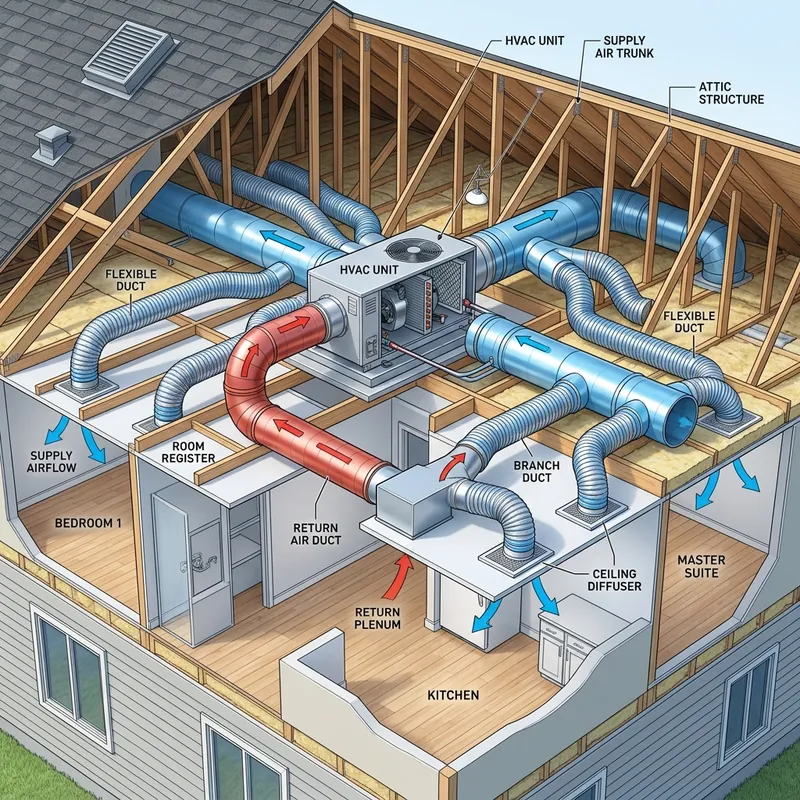
An HVAC duct calculator (also called a ductulator or duct size calculator) is a tool used to determine the correct duct dimensions for heating, ventilation, and air conditioning systems. It takes inputs such as airflow in CFM, friction loss rate, duct length, and the number of fittings to calculate the ideal duct diameter or rectangular equivalent.
Professional HVAC engineers and contractors rely on duct sizing calculators to ensure systems deliver the right amount of conditioned air to each room. Without accurate sizing, systems waste energy, create uncomfortable hot or cold spots, and generate unwanted noise.
How to Use the Duct Calculator

Using our free HVAC duct calculator is simple. Follow these steps to calculate your duct size accurately:
- 1Select your duct type (metal or flex) at the top of the calculator.
- 2Choose whether to size by friction rate or velocity. For residential systems, friction rate (0.08 in/wg per 100 ft) is the standard method.
- 3Enter your Total Effective Length (TEL), which includes the actual duct run plus equivalent lengths for all bends and fittings.
- 4Enter either your known duct size or your required CFM airflow.
- 5Click Calculate to see your results including CFM, velocity, pressure loss, and recommended duct dimensions.
Duct Sizing Formula Explained
The core formula used in HVAC duct sizing is based on the Darcy Weisbach equation and ASHRAE equal friction method. For round ducts, the relationship between airflow, duct size, and friction rate is:
Q = A × V Where Q is airflow in CFM, A is the cross sectional area of the duct in square feet, and V is velocity in feet per minute (FPM).
For a round duct, the area is calculated as A = π × (D/2)² where D is the diameter in feet. The friction rate determines how much static pressure is lost per 100 feet of duct run.
CFM = (π/4) × D² × Velocity For example, an 8 inch round duct at 700 FPM velocity delivers approximately 244 CFM of airflow. This is the standard capacity used in most residential branch duct runs.
Understanding Airflow CFM in HVAC
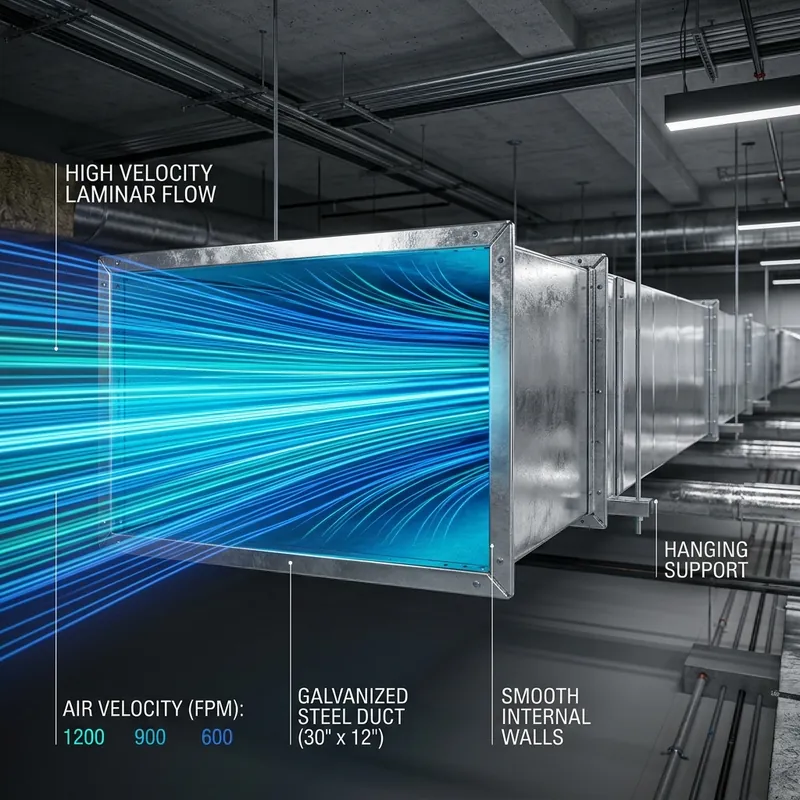
CFM stands for Cubic Feet per Minute and measures the volume of air flowing through a duct. Every room in a building requires a specific amount of airflow to maintain comfort. The required CFM depends on the room size, heat load (BTU), and the system design.
A general rule of thumb for residential HVAC is 1 CFM per square foot of floor area. For cooling, the typical requirement is 400 CFM per ton of cooling capacity. One ton of cooling equals 12,000 BTU per hour.
CFM = BTU ÷ (1.08 × ΔT) Where BTU is the heating or cooling load and ΔT is the temperature difference between supply and return air (typically 20°F for cooling).
Friction Rate and Static Pressure Explained
Friction rate is the pressure drop that occurs per 100 feet of duct length, measured in inches of water gauge (in/wg). As air moves through ductwork, it loses energy due to friction against the duct walls. The smoother the duct interior, the lower the friction loss.
Static pressure is the total resistance that the blower fan must overcome to push air through the entire duct system. It includes friction losses in straight duct runs, pressure drops across fittings, and losses through filters, coils, and registers.
For residential supply ducts, the standard friction rate is 0.08 in/wg per 100 feet. Commercial systems may use rates from 0.08 to 0.60 in/wg depending on the application and available static pressure from the air handler.
How to Calculate Total Effective Length
Total Effective Length (TEL) is a critical value in duct sizing. It represents the total resistance path that air must travel, combining the actual straight duct length with the equivalent lengths of all fittings such as elbows, tees, transitions, and takeoffs.
Each fitting adds resistance equivalent to a certain length of straight duct. Common equivalent lengths for metal ductwork include:
- 90° elbow: 10 feet equivalent length
- 45° elbow: 5 feet equivalent length
- 180° return bend: 20 feet equivalent length
- Branch takeoff: 25 to 35 feet equivalent length
TEL = Straight Length + Σ(Fitting Equivalent Lengths) For flex duct, multiply the equivalent lengths by 1.5 because the corrugated interior creates significantly more friction than smooth metal duct.
Common Duct Sizing Mistakes
Incorrect duct sizing is one of the most frequent problems in HVAC installations. Here are the mistakes that professionals and DIY installers make most often:
Undersizing ducts
Ducts that are too small restrict airflow, increase velocity and noise, raise static pressure, and force the blower to work harder. This leads to higher energy bills and reduced equipment lifespan.
Oversizing ducts
Ducts that are too large waste materials and reduce air velocity below the minimum needed for proper air distribution. Low velocity can cause temperature stratification where warm air rises and cool air settles.
Ignoring fittings in TEL
Many installers only measure the straight duct run and forget to add equivalent lengths for elbows, tees, and other fittings. This can underestimate the total resistance by 30% to 50%.
Using the wrong friction rate
Applying commercial friction rates to residential systems (or vice versa) leads to improper sizing. Always use the friction rate appropriate for your application type.
Duct Material Impact on Airflow
The material and construction of your ductwork significantly affect airflow performance, friction losses, and overall system efficiency. The two most common duct types are sheet metal and flexible duct.
🌀 Flexible Duct
Flexible ducts are made of a wire helix wrapped in plastic and insulation. They are easier and faster to install but create significantly more friction due to their corrugated interior. When using flex duct, increase your equivalent lengths by 50% and keep runs as short and straight as possible. Avoid sharp bends and compression, as these dramatically increase resistance.
Why Accurate Duct Sizing Matters
Proper duct sizing is the foundation of an efficient, comfortable, and quiet HVAC system. When ducts are sized correctly, the system delivers the right amount of air to each room at acceptable noise levels while operating at peak efficiency.
Poorly sized ductwork causes a chain reaction of problems: uneven temperatures between rooms, excessive noise from high velocity air, increased energy consumption as the blower works harder, premature equipment failure, and reduced indoor air quality from improper air circulation.
Studies show that improperly sized duct systems can increase energy consumption by 20% to 40%. For a typical home spending $2,000 per year on heating and cooling, that translates to $400 to $800 in wasted energy costs annually.
Understanding Calculator Inputs
Each input field in our HVAC duct calculator controls a specific aspect of the sizing calculation. Understanding what each field means helps you enter accurate values and get reliable results.
Duct Type: Select metal (galvanized steel) or flex (flexible duct). Metal ducts have smooth interior walls and lower friction loss. Flex ducts have corrugated interiors that increase friction by approximately 50%. The calculator automatically adjusts friction calculations based on your selection.
Sizing Method: Choose between friction rate (standard approach) and velocity (noise focused approach). Friction rate is recommended for most residential and commercial designs. Velocity method is used when noise control is the primary concern.
Friction Rate: The allowable pressure drop per 100 feet of duct, measured in inches of water gauge (in/wg). Residential supply ducts typically use 0.08 in/wg per 100 ft. Lower values produce larger, quieter ducts. Higher values allow smaller ducts but increase noise and energy use.
Total Effective Length (TEL): The combined resistance of your duct run in equivalent feet. It includes the straight duct length plus equivalent lengths for all fittings (bends, transitions, takeoffs). Our calculator lets you enter the straight length and number of bends separately.
Bend Counts: Enter the number of 45 degree, 90 degree, and 180 degree bends in the duct run. Each bend adds equivalent length: 5 feet for 45 degree, 10 feet for 90 degree, and 20 feet for 180 degree bends. For flex duct, these values are automatically multiplied by 1.5.
Duct Dimensions: Enter either the known duct size or the required CFM airflow. If you enter a duct diameter, the calculator tells you the CFM capacity. If you enter a CFM requirement, it calculates the needed duct size.
What Your Results Mean
After clicking calculate, the tool displays several output values. Each one tells you something important about how the duct will perform in your system.
💨 CFM
CFM (Cubic Feet per Minute): The volume of air flowing through the duct each minute. This must match the airflow requirement of the room or zone the duct serves. Typical residential rooms need 100 to 400 CFM depending on size.
🚀 Velocity
Velocity (FPM): The speed of air moving through the duct in feet per minute. For quiet residential operation, keep velocity below 900 FPM for supply ducts and below 700 FPM for return ducts. Higher velocities cause audible noise.
⬇️ Pressure Loss
Pressure Loss (in/wg): The total static pressure drop across the duct run. This value must not exceed the available static pressure from your blower fan. If pressure loss is too high, the duct is undersized or the run is too long.
📏 Duct Size
Recommended Duct Size: The minimum duct diameter (round) or dimensions (rectangular) needed to deliver the required airflow at acceptable velocity and pressure loss. Always round up to the next standard duct size available from your supplier.
🔇 Noise
Noise Assessment: Based on the calculated velocity, the tool indicates whether the duct will operate quietly, at moderate noise, or at potentially noisy levels. For bedrooms and offices, aim for the quiet range.
Real World Use Cases
Our HVAC duct calculator is designed for professionals and homeowners working on real projects. Here are the most common scenarios where accurate duct sizing makes the difference.
New Home Construction
When building a new home, every duct must be sized from scratch. Use the calculator to size trunk lines, branch runs, and return ducts for each room based on the Manual J load calculation. Getting it right during construction avoids expensive modifications later.
Adding a Room or Extension
Extending ductwork to a new room requires calculating whether the existing trunk can handle additional airflow. Use the calculator to verify the trunk capacity and size the new branch duct for the added room's CFM requirement.
Replacing Old Ductwork
During renovation, verify that existing duct sizes actually match the airflow needs of each room. Many older homes have undersized ducts. Use the calculator to check whether current duct sizes deliver adequate CFM at acceptable velocity.
Troubleshooting Comfort Problems
If certain rooms are always too hot or too cold, the duct serving that room may be undersized. Measure the duct diameter, enter it with the room's CFM requirement, and check if the velocity exceeds 900 FPM. If it does, the duct needs to be larger.
Supply vs. Return Duct Sizing
In a balanced HVAC system, supply and return ducts serve different functions and often require different sizing considerations:
Supply Ducts
Supply ducts deliver conditioned air to rooms. They usually operate at higher velocities (up to 900 FPM in branches) and use a friction rate of 0.1 for metal ducts.
Return Ducts
Return ducts pull air back to the air handler. They should be sized larger than supply ducts to reduce velocity (typically 400-600 FPM) and noise, often using a 0.08 or 0.05 friction rate.
Trunk Duct vs. Branch Duct
The "trunk" is the main central duct from the equipment, while "branches" are the smaller pipes feeding individual rooms.
- Trunk:
Main trunk lines carry the total system CFM. Velocity in residential trunks is usually capped at 700-900 FPM to keep the system quiet.
- Branch:
Branches carry smaller loads (e.g., 100-200 CFM). Because they are closer to the registers, velocities should be lower (600-700 FPM) to avoid "whistling" noises.
Velocity & Friction Guidance
Recommended Velocity Ranges
| Main Trunk (Supply) | 700 – 900 FPM |
| Main Trunk (Return) | 400 – 600 FPM |
| Branch Ducts | 600 – 700 FPM |
| Filter Grilles | 300 – 450 FPM |
A common "rule of thumb" is to use a 0.1 friction rate for all residential duct design. However, modern high-efficiency systems often require a lower friction rate (0.05 to 0.08) to ensure the blower can handle the static pressure load.
Important Limitations
This HVAC duct calculator is intended for planning estimates and educational purposes only. Professional duct design requires ACCA Manual D calculations which account for equipment-specific blower data, altitude, and component pressure drops. Incorrect duct sizing can lead to equipment failure, high energy bills, and poor indoor air quality. Always consult with a licensed HVAC professional for final designs.
Explore Duct Sizing Guides
Browse our comprehensive reference pages for specific duct sizes, room dimensions, and home square footage calculations.
Duct Size Calculators
CFM by Room Size
Whole Home Duct Sizing
How It Works
Select Duct Type
Choose between metal or flex ductwork based on your installation requirements.
Enter Parameters
Input your friction rate, duct length, number of bends, and duct dimensions.
Get Results
Instantly receive calculated CFM, velocity, pressure loss, and recommended duct sizing.
Common Friction Rates Reference
| Application | Rate (in/wg per 100ft) |
|---|---|
| Residential Supply | 0.08 |
| Residential Return | 0.06 |
| Commercial Low Pressure | 0.08 – 0.10 |
| Commercial Medium Pressure | 0.10 – 0.20 |
| Commercial High Pressure | 0.20 – 0.60 |
| Industrial | 0.30 – 1.00 |
Reviewed by HVAC Professional
The calculations in this tool are based on ASHRAE (American Society of Heating, Refrigerating and Air Conditioning Engineers) guidelines and the equal friction method used by professional HVAC engineers worldwide.
Verified HVAC Engineering Calculations
Last Updated: April 2026
Disclaimer: This calculator provides estimates for educational and planning purposes. Actual duct sizing should be verified by a licensed HVAC professional using Manual J (load calculation) and Manual D (duct design) procedures. Local building codes and specific equipment requirements may affect final duct sizing.
People Also Search For
Frequently Asked Questions
What is friction rate in HVAC duct sizing?
What is the difference between metal and flex ducts?
How do I calculate Total Equivalent Length (TEL)?
What duct size do I need for a given CFM?
How do I convert rectangular ducts to round equivalents?
What is a good velocity for residential ductwork?
How do I calculate duct size based on room square footage?
What is Manual J and why does it matter for duct sizing?
What is Manual D in HVAC?
What is static pressure in HVAC systems?
How do I convert BTU to tonnage for HVAC systems?
What is the difference between a ductulator and a duct calculator?
Can I use this calculator for commercial HVAC systems?
What causes noise in HVAC duct systems?
How does wrong duct sizing affect energy costs?
Compare Top HVAC Equipment, Duct Supplies & Local Contractor Deals
Looking for ductwork materials, flexible duct bundles, airflow diagnostic meters, or contractor quotes? Browse current specials.